Development3 min read
Three Reasons to Choose WordPress for Your Website
Published by Samsiani

If you are beginning to plan a website, whatever its type, you will almost certainly encounter WordPress.
Before discussing why WordPress can be a good choice, let us clear up some common misconceptions.
What exactly is WordPress?
First, we are not discussing the WordPress.com hosted platform. We mean the WordPress content management system, or CMS, which needs development and hosting, like the other websites we build.
WordPress is a powerful tool for creating and managing websites. It can support blogs, business and personal websites, and online shops.
The software is available as a set of files on the official website. You download those files for use on your hosting, rather than buying a separate device or desktop application to run the website.
With that distinction clear, here are three reasons to consider WordPress for your website.
Reliability
One way to assess a platform is to consider how widely it is used. The Kinsta research cited in the original article gave WordPress the largest share of the CMS market.
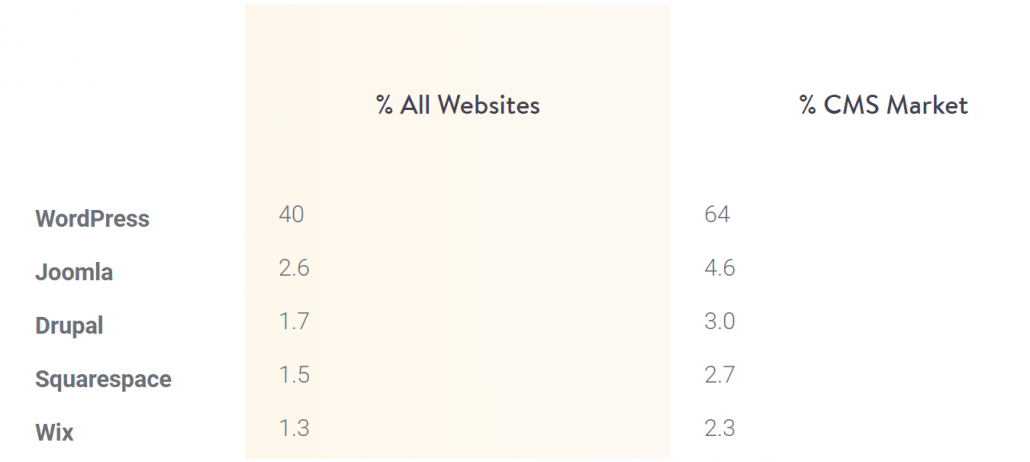
Those figures put WordPress at 64% of the CMS market, with second-placed Joomla holding a share 14 times smaller.
They also indicated that 40% of the world's websites were built on WordPress — a substantial figure.
A platform needs to earn trust to achieve such widespread adoption. Websites cited as WordPress users included TechCrunch, The New Yorker, BBC America, Microsoft News Center, CNN and many others, including the White House at www.whitehouse.gov.
The figures quoted in the article described approximately 70 million new posts and 77 million new comments on WordPress websites each month.
With around a third of websites using WordPress at the time, its adoption offered a strong indication that it was a dependable platform to consider.
Security
WordPress can provide a secure foundation, but that does not make a website immune to attacks or malware. Appropriate security measures, configuration and development are needed on both the website and its hosting server.
WordPress and its hosting tools make it easier to add protection, including measures such as password-protected directories.
Regular WordPress updates fix issues and help address potential security threats.
It is also straightforward to enable an SSL certificate, which you can usually obtain through your web hosting provider.
Speed
A slow website is frustrating to use. WordPress developers recognise this, and the platform has features and tools that can help improve loading speed.
For example, you can choose a lightweight theme that avoids unnecessary code or add a plugin to reduce image sizes.
Other options include Gzip compression, advanced caching and minification of CSS and JavaScript files.
These approaches can substantially reduce loading times. In turn, a faster website can reduce visitor drop-off, improve engagement and support conversions.
The original article noted WordPress's growing market share and projected that it might power more than 80% of the web by 2025. This was a forecast at the time of writing, not a confirmed usage figure.
More teams and companies offer WordPress website development as a service. Building these websites still requires knowledge and experience. Look for useful resources and reliable partners. Before hiring a development team, review its work and portfolio.
See also: